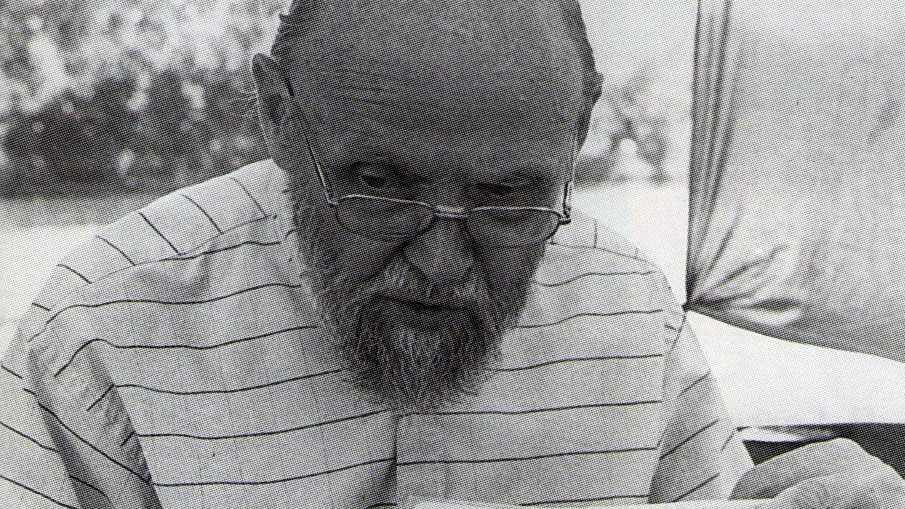
Father Larsen's boat in a period photograph - Shadows and Lights no. 87, 2004
Archival content: this article was published more than 20 years ago. The language and content reflect the sensitivities of the time.
A white boat. Seventy meters of wood and bright flowers floating on the Seine outside Paris. Whoever built it at the turn of the century to carry coal could never have imagined that by the 1930s it would become a center of social refuge—a home for those arriving in France from every corner of the world without permission, without a bed. They could not have foreseen that a crew of thirty undocumented migrants would find aboard not only a bunk and a warm invitation to stay, but a fragrant wooden chapel, a common room for sharing stories or silence, meals and songs, and four captains to trust.
One of them is Father Joseph Larsen, the reason three Roman tourists left the Cité one afternoon to venture out to Conflans-Sainte-Honorine, to the *Je Sers*—the house on water with the blue cross at its bow.
The water here was not murky as it is beneath Notre-Dame. A light breeze made the sweltering heat of late July bearable. We watched Joseph climb up the steep stairs from his bunk, his full white beard and steady, gentle eyes appearing first. We found a man of God and the world, eager to share the missionary's grand discoveries and the Christian's deep thoughts.
He spoke with us for nearly two hours—of his family and formation, of gift and poverty. "Everyone has a dream; becoming a missionary was mine," he began, recounting his childhood, the calling he felt as a boy standing before the colors of nature, his intense studies first in Vienna where he was born, then in Holland. With few words and a hint of irony in his voice, he recalled the long, patient wait—until age forty-six—half his life spent in serene obedience to those who wanted him to remain a scholar and professor of theology while he dreamed of departure for the missions.
His "finally" arrival in the Philippines marked the beginning of a new journey for Joseph—the achievement of a wholeness of life and faith. First came intellectual application, the dominance of mind, rationality, scientific control; then came trust in the voice of feeling, discovery of friendship and love: "I thank the Lord for letting me experience both paths, both cultures"—East and West, the faith of the learned in European universities, the outstretched arms of the poor of Manila. When he hears himself thanked "for the person you are, not for what you have done," his heart is troubled, and he opens himself to receive far more than he gives.
Father Larsen remained in the Philippines for twenty-four years, and he carries with him still, at eighty, after ten years in Paris, the capacity and desire to share the many stories he lived there. He shows us faces drawn on cardboard: portraits he made to support himself after deciding to leave everything and live in a hut among the poor. "I set out on a pilgrimage for twenty-three days with nothing—not even a coin—and many fears. I discovered I could draw, and that only the poor truly experience God's presence."
In the Philippines, Joseph also encountered Faith and Light and the poorest of the poor—those whose disabilities prevent them from surviving alone, who must place themselves in the hands of others: it is a "complete abandonment," and this struck and drew Father Larsen when he still knew nothing of the movement, when he let himself be drawn in, unaware of the new turn it would bring to his life. Within a few years he began traveling all of the Far East for Faith and Light—from Taiwan to Hong Kong—and in 1994, at the movement's first international gathering in Warsaw, he became its international spiritual assistant. He returned to Europe. "I'm already on my third mandate," he says, that hint of irony returning to his eyes, "but last time I was only confirmed for two years. This autumn I'll be eighty, and it's only right that I step down."
Father Joseph Larsen - Ombre e Luci n.87, 2004Reflecting on these ten years of responsibility and life in Paris, Father Larsen speaks to us above all of friendship—of the care and richness discovered each day in community. He reveals what "the Church never talks about": the most important thing in Jesus's life was friendship, strong bonds with certain people—fishermen, the poor, and as Matthew tells us, tax collectors, at whose tables he ate with great joy. To become someone's friend means discovering their mystery. Building with them a great and joyful intimacy. Like a dance. The mystery may be reluctant to reveal itself, hidden in one who has never spoken a word, never seen the blue sky, never clasped a hand. This adventurous search is the foundation of Faith and Light, the foundation of the journey that men and women—different, wounded, angry—share each day aboard the *Je Sers*, the only possible home for Joseph, returned to the West after making his own the huts and struggles of Manila's outlying neighborhoods.
Here, on the never-still planks of the boat, "strange people, sometimes unbearable," begin to come alive thanks to the welcome they receive, the openness they feel from those who believe that every man and woman deserves to be loved. We help them obtain residency permits and they stay until they find work and decent housing. Gradually they manage to push back the fear of police, the resentment and humiliation of imposed rules, and they allow themselves to be discovered. They recover the human side of their nature."
It is true—what strikes the visitor most is this: the people living on the *Je Sers* are a real crew. At table they smile at one another or argue or tease with great familiarity, despite differences of language, religion, culture, heart. And especially they smile warmly and naturally at you, curious and fascinated, investigating their course, knowing you will return safely to solid ground by evening. A harmony that, after meeting and watching Father Larsen, appears to us natural before it seems incredible, easy as it is solid.
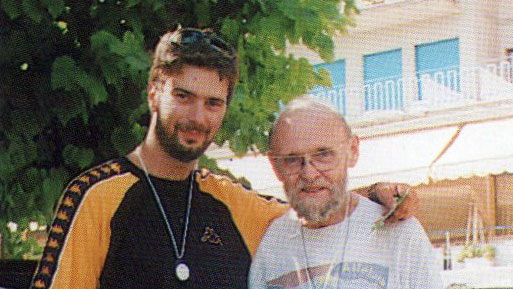
Father Joseph Larsen in Rome with a friend from Faith and Light - Ombre e Luci n.87, 2004For a few moments this charismatic man becomes our captain too—the one who can point us toward a direction and clear away some doubt. We ask him for a word to help us recover the desire to call ourselves Christian and recognize our neighbor, a message for those who see the Church as distant and unwieldy. His expression grows serious: "The Church has lost its call to love. It appeals to the head, not the heart." Young people flee the severity of the institution and the sterile rationality of catechism. "It is a grave problem." He falls silent for a few seconds. Then he looks at us and manages a new smile: "I wish—I hope—that goodness and love will be found, not so much in the Church, but in Christians." In Holland, among Protestants, numerous groups of young people already gather in the name of welcome and love, and throughout the world new movements and congregations are being born that do not announce truth but love. The Pope hosted their representatives in Rome three years ago and recognized the vital importance of these movements for Christianity's future. So this is the path to follow: "Love! Love your friends, the poor, your parents, love animals, love the little ones, and so be disciples of Jesus."
Silvia Gusmano, 2004
From morning to evening, Silvia Gusmano is surrounded by students: she moves from her children to her pupils to her children (and their friends) without interruption, in the conviction that she…